CSFA Home
Who Were the First Americans?
About CSFA
Education at CSFA
CSFA Research
Publications and Archives
Join CSFA
Support CSFA
CSFA Image Gallery
Resources on the Web
Contact CSFA
© 2002 - 2009
Center for the Study of the First Americans
All Rights Reserved.
Education


Photo of a graduate seminar at the Center


The Center for the Study of the First Americans is part of the Department of Anthropology at Texas A&M University. The department has 24 faculty members and offers BA, MA, and PhD degrees.

The Center is fully integrated into the academic curriculum of the Department of Anthropology. The Director and Associate Director regularly teach classes and participate in the education and training of graduate and undergraduate students. They have developed a set of specialized undergraduate and graduate courses for students specializing in First American studies. These include First American Archaeology, Paleolithic Northeast Asia and Alaska, Method and Theory of Peopling of the Americas, Geoarchaeology, and Lithic Technological Organization.

Both undergraduate and graduate students have the opportunity to become involved with Center research projects in both the field and laboratory. These provide numerous training experiences in diverse settings as the Texas woodlands to Alaskan arctic tundra.

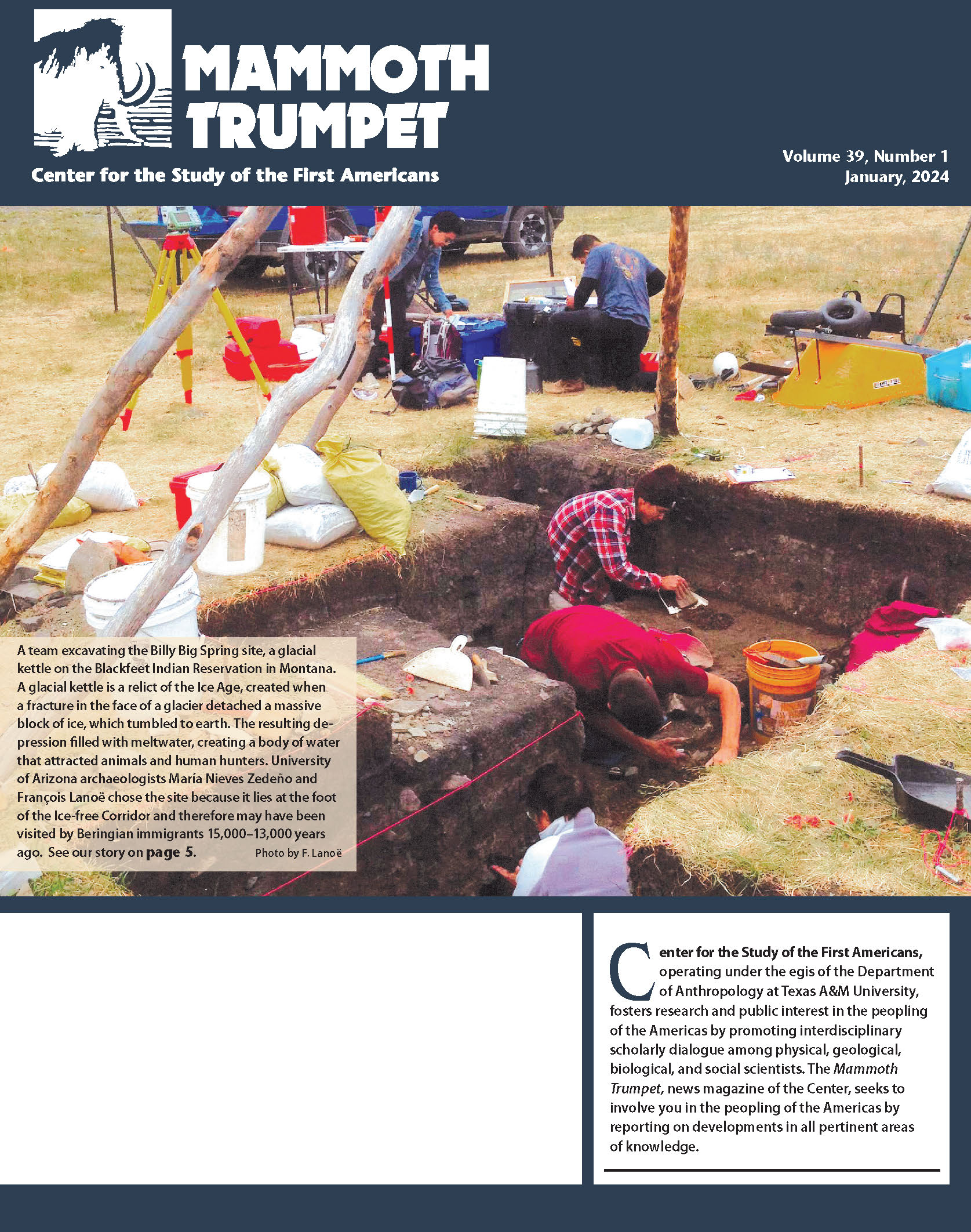
Center graduate students also take courses from other Anthropology faculty. Some examples include human behavioral ecology (M. Alvard), hunter-gatherer archaeology (A. Thoms), palynology (V. Bryant), economic archaeology (S. Eckert), zooarchaeology (D. de Ruiter), and paleoanthropology (S. Athreya). First American studies is a very interdisciplinary field. Students are encouraged Photo of excavations at the Buttermilk Creek siteto take courses in other departments and colleges across the university. Courses in geomorphology, sedimentology, pedology, ecology, and many other fields are available at Texas A&M University.

For more information about degree programs, see the Department of Anthropology website.

Photo of excavatios at Bonneville Estates Rockshelter
(top)
Current Students and their Research Projects
photo of John Blong

John Blong (Ph.D.)

I am interested in early hunter-gatherers in North America, specifically the peopling of the Americas. I am particularly interested in lithic technology and geoarchaeology. Recently, I have been involved in CSFA excavations at Buttermilk Creek and Bonneville Estates Rockshelter and am developing Paleoindian research in the mid-Atlantic region of the U.S. exploring fluted-point technology (Chair: Ted Goebel).

photo of Jessi Halligan

Jessi Halligan (Ph.D.)

I am interested in applying geoarchaeology to the peopling of the Americas and to submerged cultural landscapes. Specifically, I would like to find and excavate Terminal Pleistocene/Early Holocene sites that have been submerged by Early Holocene sea level rise. As water has always been a basic human need, my research focuses on how early North Americans interacted with the rivers, streams, and shorelines they encountered and how these environments interact, in turn, with the cultural remains people left behind (Chair: Mike Waters).

photo of Tom Jennings

Tom Jennings (Ph.D.)

I am studying the Late Paleoindian, Clovis, and potential pre-Clovis stone tool debris from the Buttermilk Creek site, Texas. Through the detailed technological characterization of the lithics, I hope to evaluate the degree to which technological continuity exists between these three assemblages and chronicle changes in mobility strategies through time (Chair: Mike Waters).

photo of Josh Keene

Josh Keene (M.A.)

I am conducting a geoarchaeological analysis of the Block A Paleoindian component at the Buttermilk Creek site, Texas. My research focuses on organizing the debitage and lithic artifacts found during excavation based on size, patination, and degree of burning. Concentrations can then be used to identify cultural horizons and recreate the sequence of deposition in an otherwise uniform series of clays. The goal of this research is to determine the context of Paleoindian periods at the site, including Plainview, Clovis, and possible pre-Clovis horizons (Chair: Mike Waters).

photo of Ashley Smallwood

Ashley Smallwood (Ph.D.)

I am studying Clovis technology in the southeastern U.S., with a specific focus on the adaptive context of Clovis biface production. I have supervised excavations at the Topper Clovis site in South Carolina since 2005, and I am analyzing the lithic assemblage from this site as well as assemblages from the other important Clovis sites in the Southeast, including Williamson. The goal of my dissertation is to identify the signatures of Southeastern Clovis biface technology and the organization of this industry to culturally define Clovis in the region (Chair: Ted Goebel).

photo of Heather Smith

Heather Smith (Ph.D.)

I am conducting a shape analysis of Clovis projectile points to document and explain similarities and differences between points at different sites. I am interested in all aspects of the peopling of the Americas, particularly Paleoindian technological adaptation. At the heart of my research interest is human movement, lithic rejuvenation, and residue analysis (Chair: Ted Goebel).

(top)
Former Students and Their Research Projects

Charlotte Pevny (Ph.D. 2009)

Dissertation title: Clovis Lithic Debitage from Excavation Area 8 at the Gault Site (41BL323), Texas: Form and Function


Juan Urista (M.A. 2009)

Thesis title: Stratigraphy and Geochronology of the Vernor Mammoth Site, Clute, Brazoria County, Texas


Victor Galan (Ph.D. 2008)

Dissertation title: Excavation, Analysis, and Behavior of the Hegar and Texas Caches in Southeast Texas.


Dawn Alexander (M.A. 2008)

Thesis title: Geoarchaeological Investigation of Natural Formation Processes to Evaluate Context of the Clovis Component at the Gault Site (41BL323), Bell Country, Texas


Scott Minchak (M.A. 2007)

Thesis title: A Microwear Study of Clovis Blades from the Gault Site, Bell County, Texas


Heidi Luchsinger (Ph.D. 2006)

Dissertation title: The Late Quaternary Landscape History of the Middle Rio Negro Valley, Northern Patagonia, Argentina: Its Impact on Preservation of the Archaeologiucal Record and Influence on Late Holocene Human Settlement Patterns.


Michael Aiuvalasit (M.A. 2006)

Thesis title: Geoarchaeological Investigation at the McNeill-Gonzales Site (41VT141), Victoria County, Texas.


William Dickens (Ph.D. 2005)

Dissertation title: Biface Reduction and Blade Manufacture at the Gault Site 41BL323: A Clovis Occupation in Bell County, Texas.


James Wiederhold (M.A. 2004)

Thesis title: Toward the Standardization of Use-Wear Studies: Constructing an Analogue to Prehistoric Hide Work.

(top)

If you would like to learn more about the Graduate Program in the Department of Anthropology at Texas A&M University, please contact us by phone at (979) 845-5242, or by email at anthro@tamu.edu.